I find myself wanting to get back into hiking again - by which I mean, completing sections of trail and getting badges for them, because I do better with specific goals and rewards to work towards rather than just the vague idea of "go for a walk". But it almost feels like a doomed effort at this point, with too many barriers in the way.
Wednesday, August 7, 2024
The Trail Is A-Callin'
Friday, July 26, 2024
Chasing Achievements
On the subject of Bruce Trail badges, a few of the other clubs have also started offering naturalist-themed badges, and I've already taken advantage of two of them. The Toronto club's "biodiversity naturalist" badge requires a certain number of observations from various categories (birds, trees, wildflowers, mushrooms, etc.) found within the Toronto section of trail. I spent some time in and around Hilton Falls Conservation Area this spring and managed to check off that list without too much trouble; it was a really good spring for wildflowers and other plants. The Caledon club's "citizen scientist" badge, in comparison, requires 100 different species reported to the BTC's iNaturalist project but they can be anything from anywhere along the entire trail, not just the Caledon club section. So between the stuff from Toronto for the other badge, a bunch of older observations that I logged during past hikes, and some extra photos taken during field work down in Burlington this year, I managed to get that one too.
Wednesday, July 24, 2024
Dragon Hunting
This year, for the first time since pre-pandemic, I was able to take part in the Hamilton Ode Count. Fortuitously, I ended up being assigned to the location I've been trying to get to for a few years now, in order to see (some of) the very species that I ended up seeing.
![]() | |||
| Amber-winged Spreadwing (Lestes eurinus) |
I didn't realize what I had on this one until later when I was sorting my photos. I knew it was a spreadwing, but I wasn't able to net one so I thought I'd be hooped without a close-up of the cerci to ID from. But those wings are unmistakable, and in retrospect I do remember thinking that it was just big for a spreadwing, way too big to be a Slender Spreadwing even though it did seem proportionally thinner through the abdomen than others in that group.
![]() |
| Dusky Dancer (Argia translata) |
Sadly did not photograph all that well, but there are small rings of bright blue on the abdomen that serve to ID it as Dusky along with the overall dark colouration. Very cool species.
![]() |
| Rainbow Bluet (Enallagma antennatum) |
A female, lovely lime-green overall with yellow-orange face and legs, and blueish post-ocular spots. Thought it was a female forktail at first, since it was about the right size and I'd seen many forktails flying around already that day, but something just didn't seem right about it, so I'm glad I followed my instincts and snagged it for a closer look.
Odes are just great, you guys. I still have vague thoughts at trying to start an actual ode survey for my home county to feed into a local rarity ranking system, but that is such a huge thing to consider that I'm still too intimidated.
Yet Another Rabbithole
So lately I've been going down the mushroom rabbithole - I blame the Bruce Trail and their shiny, shiny badges, because Beaver Valley released a 'mushroom hunter' badge that is gorgeous and I need it like burning. So clearly I needed to practice mushrooms, which led to reading about mushrooms and photographing mushrooms....
Yeah.
![]() |
| Goblet Waxcaps (Hygrocybe cantharellus) |
Mushrooms are... frustrating, so far, in many ways. I've been spoiled by birds and butterflies and dragonflies and wildflowers, which are all (relatively) big showy things with (sometimes) big identifiable field marks and (mostly) easily accessible and comprehensive field guides. Mushrooms... are not those things. There are so very many of them, and a lot of them look the same, and identification frequently comes down to putting things under a microscope and even then apparently sometimes it just doesn't work out for a variety of reasons. There are generic mushroom field guides available, sure, but after picking through a few of them trying to work out an ID, I'm not convinced they're actually functional considering how many species have to get left out in order not to have a massive three-volume tome. And there's an entire new language of technical terms to learn in order to know what they're talking about half the time.
So yeah, here's me, overconfident, thinking I'll just wander around with my camera and pick it up no problem. I know that you have to flip over the cap and see what the gills (or pores, or lack thereof) look like, I know you should take note of what the habitat is and what they're growing on. Surely that's got to be enough to start from, right?
![]() |
| ????? |
Sigh.
I am getting a little better. I haven't tried doing a spore print yet, although it's probably only a matter of time, for curiousity's sake if nothing else. I... am not sure I will ever get to the point where I want to collect a bunch and put them under a microscope, but hey, never say never, there was a point where I didn't think I'd ever be as much of a birder as I am now, either. Anything is possible.
At the very least, I'm gonna get that badge. And then we'll see.
![]() |
| Violet-toothed Polypore (Trichaptum biforme) with Fairy Pins (Phaeocalicium polyporaeum, technically a lichen but whatever; they're the tiny black bips growing on the top of the cap) |
![]() |
| Oak Mazegill (Fomitopsis quercina) |
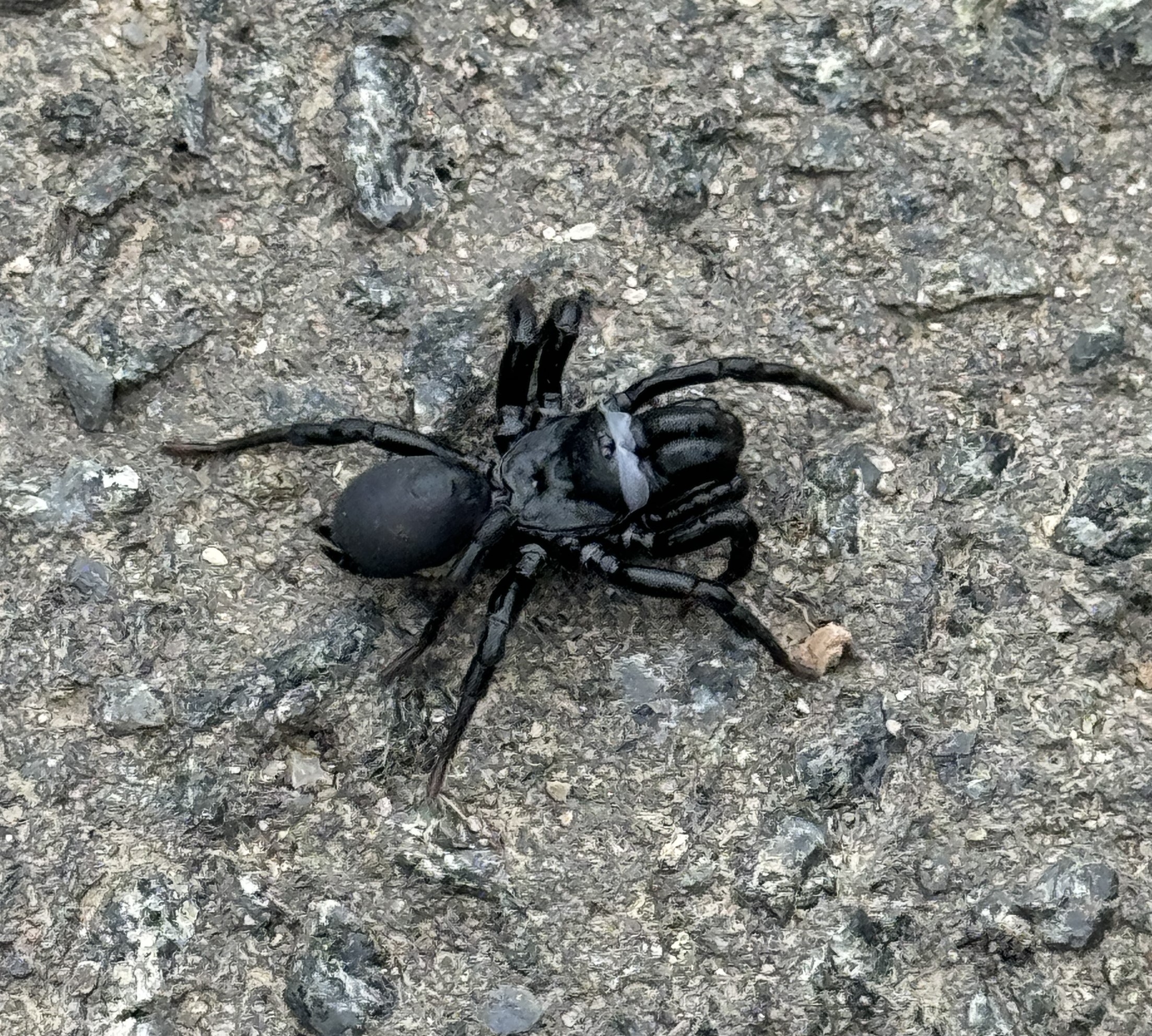
Ontario's Native Tarantula
Alright, I'm probably going to do like three posts in a row here, because apparently I only remember I have a nature blog once a year and need to catch up.
We'll start out quick and simple by saying: look at this cool spider that I found.
| Black Purseweb (Sphodros niger) |
I was doing a bird survey and noticed this black thing trundling its way across the road nearby. Decided to go have a quick look, snapped a few photos, thought it looked pretty weird but, well, I had birds to count so I kind of put it out of my mind until later.
Apparently little buddy here is Ontario's only native tarantula - or, well, as close as we get to one. It's in the same general genetic grouping as tarantulas. It was about the size of a nickel, maybe, and certainly moved in a way reminiscent of its bigger tropical cousins in the way that the legs flexed, so I can see it. They're considered rare in Ontario, but it's suspected that's because they live underground and the only time humans notice them is when the males go wandering around in search of mates for a brief period in the middle of the summer - something that I just happened to stumble upon.
I still have a touchy relationship with spiders, if I'm being honest. Most of the time these days, I can appreciate spiders out in the wild the way I would any other bug, as something to study and be curious about but ultimately leave to their own devices. If they're in my home, then the story is likely to be different, but luckily that is unlikely to ever be an issue for these guys.
Wednesday, February 7, 2024
Sunshine and Ambition
We have officially hit the time of year where the days are starting to get noticeably longer and I have enough distance from last year's field season to regain some enthusiasm about being outside, but also it's still winter (albeit barely, this year) and thus I haven't seen green growing things in months. All of this combines to have me sitting here making wildly ambitious and unrealistic plans for all of the stuff I'm going to do this spring and summer, because daydreaming about dragonflies is infinitely better than writing reports.
Today I'm apparently determined I'm going to single-handedly survey dragonflies and damselflies for my entire County and develop the kind of species abundance checklist that other local municipalities have - basically a document that lists the species that you might find in a geographic area and indicates how common or uncommon each species is overall within that area. Obviously that sort of thing requires a lot of data fed into it, to know the species found, and where and how many and at what times of year and in association with what habitats, so I'm also apparently plotting how to stir up the local naturalist's club and get more bug events into the outdoor programming menu, which would certainly mean volunteering to coordinate some of the events. And while I'm at it, I might as well contact the provincial wildlife agency and see if there's been any move to reopen the old Ontario odonata atlas project, maybe I could get involved with that as well, and overlap the two.
No problem, right? Definitely all stuff I'll have time for in the middle of my busiest work season when I typically want to spend all of my down time at home hiding from the sun.
*sigh*
If I didn't have to keep myself fed and housed I would do so much science, you guys.
Friday, May 5, 2023
New Year, Fewer Goals
Monday, January 30, 2023
2022 Wrap-up
Guess I never did post the end of this, did I?
- 205. Semipalmated Plover
- 206. Caspian Tern
- 207. Semipalmated Sandpiper
- 208. Great Egret
- 209. Pectoral Sandpiper
- 210. Short-billed Dowitcher
- 211. Solitary Sandpiper
- 212. Black-bellied Plover
- 213. Ruddy Turnstone
- 214. Wilson's Phalarope
- 215. Rusty Blackbird
- 216. Fox Sparrow
- 217. Surf Scoter
- 218. Black Scoter
- 219. Tundra Swan
- 220. Horned Grebe
- 221. Razorbill
- 222. Red-throated Loon
- 223. Iceland Gull
- 224. Lesser Black-backed Gull
A bit of time on the Hamilton waterfront and another December trip to Niagara worked the usual magic. Finally got my Lesser Black-backed, which is the one that got away on that same trip last year.
I probably could have pushed it even further, but I honesty kind of lost steam in the fall and winter and didn't go out nearly as much. Just proves to me that I could never do a real Big Year; I think it'd be exhausting.
Tuesday, August 9, 2022
June-July Recap
- 198. Clay-colored Sparrow
- 199. Common Gallinule
- 200. Canada Warbler
- 201. Green Heron
- 202. Horned Lark
- 203. American Kestrel
- 204. Lincoln's Sparrow
Summer is definitely slower in terms of new species and, eventually, bird activity in general. I really noticed this year when the dawn chorus stopped, effectively signalling the end of breeding season for 2022.
However, August brings with it the beginning of fall migration (yes, really; as soon as nesting finishes some birds are already on their way south, so it starts much earlier than most would think and stretches out over a far longer time period than spring migration does). And fall also tends to be better around here for shorebirds since water levels are typically lower in late summer, providing better foraging habitat along shorelines. So while I've been kind of taking a break from birds the last little while, I expect that the coming months will tempt me back out again.
Monday, May 30, 2022
Migration Madness
I took a short trip to Point Pelee in early May, like I've been saying I was going to do since I came back from my first trip there... five years ago now? More? I had what felt like a very good trip, and saw all of the species that I had hoped I was going to. Then, of course, two days after I came home, I happened to read the park birding report where they were like: best day at Pelee ever! So many birds! Weird rare species galore! So, clearly I mis-timed by trip by two days ;)
Mid-May there was the Great Canadian Birdathon fundraiser, which involved a full day of intensive birding in my home region. Then at the end of the month, I did the Carden Challenge again - actually in Carden for the first time since 2019! - for another 24 hours of intensive birding (mixed with hunting for other critters too, of course). Plus my usual volunteer migration monitoring at the Eramosa site started up again in May, plus field season really ramped up at work.
So I guess what I'm trying to say is:
- 126. Sharp-shinned Hawk
- 127. Wood Thrush
- 128. Grasshopper Sparrow
- 129. Bobolink
- 130. Ovenbird
- 131. Gray Catbird
- 132. Common Yellowthroat
- 133. Black-throated Green Warbler
- 134. Northern Waterthrush
- 135. Black-and-white Warbler
- 136. Dunlin
- 137. Baltimore Oriole
- 138. Great Crested Flycatcher
- 139. Prothonotary Warbler
- 140. Northern Parula
- 141. Rose-breasted Grosbeak
- 142. Orchard Oriole
- 143. Red-headed Woodpecker
- 144. Warbling Vireo
- 145. Nashville Warbler
- 146. Cape May Warbler
- 147. Least Flycatcher
- 148. Yellow-breasted Chat
- 149. Ruby-throated Hummingbird
- 150. White-eyed Vireo
- 151. Blue-winged Warbler
- 152. Magnolia Warbler
- 153. Blackburnian Warbler
- 154. Chestnut-sided Warbler
- 155. Black-throated Blue Warbler
- 156. Indigo Bunting
- 157. Black Tern
- 158. Marsh Wren
- 159. Least Sandpiper
- 160. Spotted Sandpiper
- 161. Greater Yellowlegs
- 162. Lesser Yellowlegs
- 163. Willow Flycatcher
- 164. Eastern Kingbird
- 165. Scarlet Tanager
- 166. Purple Martin
- 167. Red-eyed Vireo
- 168. American Redstart
- 169. Eastern Wood-Pewee
- 170. Chimney Swift
- 171. Bay-breasted Warbler
- 172. Wilson's Warbler
- 173. Swainson's Thrush
- 174. Philadelphia Vireo
- 175. Veery
- 176. Alder Flycatcher
- 177. Yellow-billed Cuckoo
- 178. Black-billed Cuckoo
- 179. Tennessee Warbler
- 180. Wilson's Snipe
- 181. Common Nighthawk
- 182. Blue-headed Vireo
- 183. American Bittern
- 184. Common Tern
- 185. Eastern Whip-poor-will
- 186. Barred Owl
- 187. Blackpoll Warbler
- 188. Golden-winged Warbler
- 189. Yellow-bellied Sapsucker
- 190. Yellow-bellied Flycatcher
- 191. Mourning Warbler
- 192. Upland Sandpiper
- 193. Loggerhead Shrike
- 194. Least Bittern
- 195. Vesper Sparrow
- 196. Yellow-throated Vireo
- 197. Hooded Warbler
Yeah. I'm not really worried about getting to 200 anymore? There's two species, at least, that I'm 100% sure I can get this summer locally, and more that are a bit harder to find but I definitely have a chance at. Beyond those, it's possible to keep climbing but I know I'd have to work a bit harder for it. I mean, there's a finite number of birds that it's possible to see, and we've already run through winter --> migration --> summer so now we're just going to do the same in reverse. Still, it'll be interesting to see how far I can actually get.